Best disc golf basket

First, the honest answer: you do not need a basket to start, because public courses are free and already have them. A practice basket is for putting at home — and since putting is where rounds are won, a home basket is the fastest way to lower your score once you are ready to drill it. The job of a basket is simple: catch the putts you make and be honest about the ones you miss. This guide explains the specs that decide that, tiered from portable to permanent, then points you to the picks once they are verified.
A note on how to read this. There is no single best basket, because the right one depends on whether you want something portable for the yard or a permanent target that catches like a course basket. So the value here is the framework — chain count, catch reliability, portability, assembly and build — applied across the tiers. Pick the tier first, then compare.
How to choose a basket
Five things decide whether a basket holds your putts and suits your use. Run any basket through these — they are exactly the columns in the comparison below.
Chain count and configuration
Chains stop the disc and drop it into the tray. More chains, arranged in inner and outer rows, catch putts arriving at different angles and speeds. A well-configured chain set is the single biggest reason a good putt stays in. Cheap baskets with too few chains let putts punch through or deflect — and a basket that rejects good putts teaches you nothing.
Catch reliability
This is the bottom line: does a putt that hits the chains actually stay in, or spit out? It depends on chain count and length, tray depth, and overall geometry. A reliable basket rewards a good putt and is honest about a bad one, so your practice means something. Catch reliability is what you are really paying for as you move up the tiers.
Portability
A portable basket folds or breaks down, weighs little, and often includes a carry bag, so you can move it to a field or the far end of the yard. A permanent basket trades portability for a heavier, more reliable build that lives outdoors. Decide which you need first — it is the biggest fork in the decision and it sets your tier.
Assembly
Some baskets snap together in minutes with no tools, which is ideal for a basket you set up and pack away each session. Others, especially permanent models, need tools and a level patch of ground. If quick setup matters to you, check the assembly note before buying — it is easy to overlook and annoying to discover later.
Build and material
Build quality — the gauge of the metal, the finish, the quality of the chains and welds — decides whether a basket survives weather and years of use or rusts and sags. A permanent basket should be built to live outdoors through the seasons; a portable can be lighter, but still wants decent chains and a stable base so it does not tip on a windy day.
The baskets compared
A short list of widely available baskets across the tiers, compared on the five specs above. Specs are verified against manufacturer listings and current Amazon listings — no hands-on testing claims, just the specs that decide whether a putt stays in.
| Best for | Chain count | Catch reliability | Portability | Assembly | Build / material |
|---|---|---|---|---|---|
| Best overall | 24 chains (12 outer, 12 inner) | Excellent — equidistant dual-tier spacing minimizes cut-throughs | Portable | 6-piece tool-free; assembles and disassembles in under 1 minute | All-metal; electrophoresed base coat + powder-coated shell; zinc-coated chains |
| Best portable / practice | 24 chains (12 outer, 12 inner) | Good — same dual-tier geometry as the Pro; slightly lighter-gauge wire | Portable | 6-piece tool-free; includes optional ground stakes | All-metal, powder-coated; ~25% lighter wire gauge vs. Black Hole Pro |
| Best budget | 24 chains (select 24-chain variant) | Good for practice — galvanized chains catch most putts; lighter gauge than premium brands | Portable | Collapsible; tool-free; includes 3 ground stakes and carry bag | Powder-coated iron frame; galvanized iron chains; 25.2" basket diameter |
| Best permanent / backyard | 30 chains (12 outer, 12 middle, 6 inner — three-tier system) | Excellent — three-tier geometry virtually eliminates cut-throughs; 8mm heavy-gauge wire | Semi-permanent (portable with optional ground stakes) | 6-piece tool-free; heavier than standard Pro but same process | All-metal 8mm wire cage; electrophoresed + powder-coated shell; zinc-coated chains |
| Best for kids / starter | 12 chains (single tier) | Good for recreational play; 12 chains suit a learning and casual pace | Portable — collapses flat; includes matching tote bag and shoulder strap | Sets up in seconds with no tools; collapses completely flat for storage | Lightweight metal frame; quick-dry mesh basket tray; 5-leg wide base; galvanized chains |
Our top picks
Best overall: MVP Disc Sports Black Hole Pro 24-Chain Portable Disc Golf Basket Target

Best overall
MVP Disc Sports Black Hole Pro 24-Chain Portable Disc Golf Basket Target
MVP Disc Sports
- Chain count: 24 chains (12 outer, 12 inner)
- Catch reliability: Excellent — equidistant dual-tier spacing minimizes cut-throughs
- Portability: Portable
- Assembly: 6-piece tool-free; assembles and disassembles in under 1 minute
- Build / material: All-metal; electrophoresed base coat + powder-coated shell; zinc-coated chains
- Best for: Serious recreational players wanting near-course-quality putting practice
The MVP Black Hole Pro is one of the most respected portable baskets on the market, delivering PDGA-approved dimensions and a 24-chain dual-tier system that catches consistently from all angles. Its all-metal build holds up well to regular outdoor use.
Last checked 2026-05-21
Best portable / practice: MVP Disc Sports Black Hole Lite 24-Chain Disc Golf Basket Target
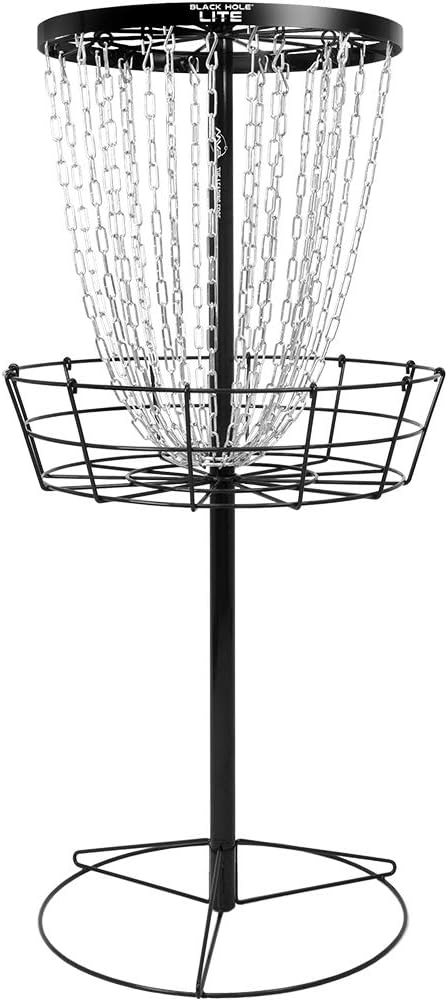
Best portable / practice
MVP Disc Sports Black Hole Lite 24-Chain Disc Golf Basket Target
MVP Disc Sports
- Chain count: 24 chains (12 outer, 12 inner)
- Catch reliability: Good — same dual-tier geometry as the Pro; slightly lighter-gauge wire
- Portability: Portable
- Assembly: 6-piece tool-free; includes optional ground stakes
- Build / material: All-metal, powder-coated; ~25% lighter wire gauge vs. Black Hole Pro
- Best for: Players who want a quality basket they can carry to the park or a friend's yard
The Black Hole Lite sheds about 9 lbs from the Pro model while retaining the same 24-chain catching system and PDGA-compliant dimensions, making it the go-to portable pick for players who move their basket frequently.
Last checked 2026-05-21
Best budget: Yaheetech Disc Golf Basket Portable Disc Golf Practice Set 12/24 Chain w/Basket Target and Double Steel Chains for Outdoor

Best budget
Yaheetech Disc Golf Basket Portable Disc Golf Practice Set 12/24 Chain w/Basket Target and Double Steel Chains for Outdoor
Yaheetech
- Chain count: 24 chains (select 24-chain variant)
- Catch reliability: Good for practice — galvanized chains catch most putts; lighter gauge than premium brands
- Portability: Portable
- Assembly: Collapsible; tool-free; includes 3 ground stakes and carry bag
- Build / material: Powder-coated iron frame; galvanized iron chains; 25.2" basket diameter
- Best for: Beginners and casual backyard players wanting a first basket without a large investment
The Yaheetech 24-chain is the most accessible entry point in the disc golf basket category, bundled with a carry bag and ground stakes at an entry-level price. Build quality is lighter than name-brand options but sufficient for recreational backyard practice.
Last checked 2026-05-21
Best permanent / backyard: MVP Disc Sports Black Hole Pro HD 30-Chain Disc Golf Basket

Best permanent / backyard
MVP Disc Sports Black Hole Pro HD 30-Chain Disc Golf Basket
MVP Disc Sports
- Chain count: 30 chains (12 outer, 12 middle, 6 inner — three-tier system)
- Catch reliability: Excellent — three-tier geometry virtually eliminates cut-throughs; 8mm heavy-gauge wire
- Portability: Semi-permanent (portable with optional ground stakes)
- Assembly: 6-piece tool-free; heavier than standard Pro but same process
- Build / material: All-metal 8mm wire cage; electrophoresed + powder-coated shell; zinc-coated chains
- Best for: Dedicated backyard disc golfers who want the closest thing to a permanent course basket
The Black Hole Pro HD adds a third inner chain tier and heavier 8mm wire throughout, delivering a catching experience that mirrors professional courses. At ~50 lbs it stays put in a yard and can be ground-staked for semi-permanent installation.
Last checked 2026-05-21
Best for kids / starter: Innova DISCatcher Traveler Disc Golf Target Basket (Blue)

Best for kids / starter
Innova DISCatcher Traveler Disc Golf Target Basket (Blue)
Innova
- Chain count: 12 chains (single tier)
- Catch reliability: Good for recreational play; 12 chains suit a learning and casual pace
- Portability: Portable — collapses flat; includes matching tote bag and shoulder strap
- Assembly: Sets up in seconds with no tools; collapses completely flat for storage
- Build / material: Lightweight metal frame; quick-dry mesh basket tray; 5-leg wide base; galvanized chains
- Best for: Kids, beginners, and families who need the lightest, most packable option
At just 15 lbs the DISCatcher Traveler is the lightest full-size disc golf basket from a major brand, designed for easy transport and frequent setup. Its fold-flat design and included tote bag make it ideal for small yards, travel, and younger players.
Last checked 2026-05-21
Who should buy what
A new player drilling putts at home
A portable practice basket is the right buy. You want something you can set up in the yard, putt at for twenty minutes, and fold away. Do not overspend on a permanent basket before you know you will use it. And there is no rush — courses are free, so the basket is purely a practice upgrade.
A committed player or a backyard hole
Step up to a mid-range or permanent basket. The better catch reliability makes practice meaningful, and a permanent basket that lives outdoors turns a corner of the yard into a real practice hole. Match the build to the weather it will sit in year-round.
Kids and casual family play
A lighter portable basket is easiest for kids to set up and move, and the lower stakes mean catch reliability matters a little less. Light and simple beats heavy and serious for casual backyard rounds.
Beyond the basket: carrying your kit
A basket lives in the yard, but the discs you practise with travel with you to the course. Once you carry more than a few discs, a proper bag keeps them organised and frees your hands — it is the natural companion purchase. See the best disc golf bag guide for how to match capacity, carry system and pockets to the way you play. And to sharpen the disc you putt with most, the best disc golf putters guide covers what makes a putter reliable.
Frequently asked questions
Do I need a disc golf basket to practise?
No — public courses are free and already have baskets, so you can play and practise putting on a course at no cost. A practice basket is for putting at home, which is the single fastest way to lower your score because you can get hundreds of reps in your own yard. It is a worthwhile but optional purchase.
How many chains should a good basket have?
More chains, arranged in inner and outer rows, catch putts coming in at different angles and speeds. Quality baskets use a denser, well-configured chain set that reduces spit-outs (putts that hit the chains but bounce out). Cheap baskets with too few chains let good putts punch through. Chain count and configuration are the biggest predictor of catch quality.
What is the difference between a portable and a permanent basket?
A portable basket is lightweight, folds or breaks down, and often comes with a carry bag so you can move it to a yard, field or park. A permanent basket is heavy, fully assembled, and built to live outdoors in one spot, catching like a course basket. Portable trades some catch reliability for movability; permanent trades movability for a course-quality catch.
How much should a practice basket cost?
Roughly $60 to $120 for a portable practice basket, $120 to $200 for a sturdier mid-range model, and $200 to $300-plus for a permanent backyard basket. The price mostly buys chain count, catch reliability and build quality. A portable practice basket is the usual first buy, and it is plenty for home putting drills.
Will a cheap basket catch putts as well as an expensive one?
Usually not. The most common compromise on a budget basket is fewer chains and a shallower tray, which means more spit-outs — putts that hit but do not stay in. That can be frustrating because you cannot fully trust the result. A budget basket is fine for casual practice; if reliable catching matters, step up a tier.
Are practice baskets hard to assemble?
Portable baskets often snap together in a few minutes with no tools, which is part of their appeal. Heavier permanent baskets take longer and may need basic tools and a level patch of ground. Check the assembly note before you buy if you want something quick to set up and pack away between sessions.
Is a basket worth it for a beginner?
Only once you want to drill putting at home. Putting is where rounds are won, and a home basket lets you practise far more than course time alone. But there is no rush — courses are free, so plenty of players wait. If you are committed and want to improve fast, a portable practice basket is a high-value upgrade.